Source Tri Clamp Sanitary Pipe Fitting for Dairy, Beer, and Beverage
Find and compare 28 Tri Clamp Sanitary Pipe Fitting options from Chinese manufacturers. Evaluate SS304 and SS316L models with F Clamp or Suspension structures for dairy, beer, and beverage applications. Check sizes from 1/2" to 12" and request quotes for standard or nonstandard configurations.
Key considerations
Products List


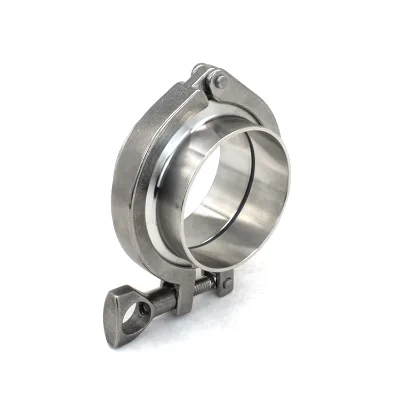
![[Ruoteng] Sanitary Pipe Fitting Stainless Steel Double Pin Tri Clamp SMS DIN ISO 3A Clamp](https://image.made-in-china.com/221f0j00bMLWzrEIqoYi/-Ruoteng-Sanitary-Pipe-Fitting-Stainless-Steel-Double-Pin-Tri-Clamp-SMS-DIN-ISO-3A-Clamp.webp)



Comprehensive Sourcing Guide
Tri Clamp Sanitary Pipe Fitting Sourcing Guide
Tri clamp sanitary pipe fittings are among the most widely sourced components in hygienic process lines, and buyers who approach sourcing systematically secure better consistency across repeat orders. The category covers clamps, ferrules, gaskets, and related fittings designed for quick-disconnect assembly in clean-in-place environments. Listings observed across the category show stainless steel construction, round head types, and compatibility with widely used standards such as GB, DIN, ANSI, BSW, and JIS, giving buyers a strong baseline of interchangeable options.
This guide organizes the sourcing decision into six areas: scope of what is actually offered, technical verification, documentation, commercial terms, supplier qualification, and long-term procurement discipline. Buyers in North America, South America, Europe, and the Middle East—as noted in observed export market listings—will find that the same verification framework applies regardless of destination. The goal is to help purchasing teams move from a listing page to a defensible purchase order with clear expectations on material, finish, dimensional compliance, and delivery terms agreed before payment.
Product Scope and Observed Listing Signals
Observed listings in this category span sanitary clamps and fittings intended for milk, juice, beer, beverage, and pharmacy applications, with some listings explicitly naming dairy products and food processing more broadly. Size ranges are broad: some listings cover 1/2" through 12", others extend to 20", and several note that larger sizes can be customized. Available models cited include 13mhh, 13mhhm, 13mhp, 13mhhs, JN-CL 1007, QL-Clamp, and ql63, indicating model-specific rather than fully standardized offerings. Buyers should map each listing's stated size range and model against their own line drawings before comparing prices.
Structural variations also matter. Listings describe F clamp structures, suspension clamps, heavy duty and light duty clamp weights, wing or round nuts, and clamped or welded connection options. Price observations in the category range from roughly $0.10 to $80 per unit, and MOQs range from 1 piece to 1,000 pieces, so a single search can surface both sample-friendly and volume-oriented offers. Treat these as observations of individual listings—not category-wide guarantees—and confirm which configuration a quoted price actually covers.
Technical Specifications to Verify
Material is the first technical checkpoint. Listings commonly state SS304 or SS316L body material, and some cite raw material as forging or casting, which affects grain structure and pressure integrity. Buyers should request mill test certificates tying each heat of stainless steel to the shipped batch, and clarify whether nickel-plated surface treatment—mentioned in some listings—applies to their application or whether bare sanitary stainless is required. Confirm that the specified grade covers all wetted parts, not just the clamp body.
Surface finish and dimensions form the second checkpoint. Observed listings cite inner surface finish of Ra 0.5 and external finish of Ra 0.8, figures consistent with hygienic expectations, but buyers should verify how finish was measured and on which surfaces. Dimensional conformance matters equally: verify that ferrule dimensions match the clamp and gasket profile, confirm the applicable standard (DIN, ANSI, SMS, ISO, BS, BPE, RJT, 3A, or IDF are all referenced in listings), and check welding preparation if welded connections are specified. Request sample parts for gauge verification before committing to volume orders.
Compliance and Safety Documentation
Certification claims should be documented, not assumed. One observed listing cites CE certification, and buyers should ask for the certificate number, scope, and issuing body to confirm it covers the specific fitting type and size being purchased. Where the destination market requires additional conformity evidence—food-contact declarations, material composition statements, or specific hygienic design attestations—the buyer should request these in writing during the quotation stage rather than after shipment, when leverage is weakest.
Documentation discipline extends to traceability. Ask suppliers to provide material certificates linked to heat numbers, surface finish measurement records for polished components, and dimensional inspection reports referencing the stated standard. For pharmacy and food applications, buyers should verify which documentation package the supplier can routinely supply and which items incur extra cost or lead time. A supplier who hesitates to share certificates for prior shipments is a warning sign; a supplier who provides them proactively demonstrates the process maturity needed for audit-ready procurement in regulated hygienic industries.
Cost Drivers and Commercial Terms
Observed price points range from about $0.10 to $80, a spread driven by size, material grade, finish requirement, structure type, and order volume. Heavy duty clamps cost more than light versions; customized sizes above standard ranges carry tooling or setup charges; 316L commands a premium over 304; and tighter surface finish tolerances add polishing cost. Buyers should break a quotation into these components so that competing offers can be compared on identical specifications rather than headline prices that hide differences in material or finish.
Commercial terms deserve equal scrutiny. MOQs in observed listings run from 1 piece to 1,000 pieces, so sample orders and production orders may follow entirely different pricing structures. Confirm what packing is included—bubble bags, inner cartons with plywood cases, wooden cases, or export-standard packing suitable for sea or air transport—and whether that packing protects polished surfaces adequately. Clarify Incoterms, shipping method (sea, air, or courier, as some listings note), payment terms, and warranty handling for defective parts before issuing a purchase order, and put all agreed specifications in the order documents themselves.
Supplier Qualification and Quality Control
Production capability signals help separate qualified suppliers from traders. Observed listings cite LG Mazak CNC machines and general CNC machining, forging or casting raw material routes, and origins in Wenzhou, Zhejiang, China—a recognized cluster for sanitary fittings. Buyers should ask whether machining, polishing, and assembly happen in-house or are subcontracted, since in-house control typically yields better consistency. Request details on incoming material inspection, in-process checks, and final inspection procedures, and ask how nonconforming batches are handled.
Quality control should be verified through evidence rather than assurances. Practical steps include ordering samples from the intended production batch process, conducting dimensional and finish checks against the agreed standard, and performing an incoming inspection on the first production shipment before release to stock. For ongoing supply, agree on an AQL sampling plan, retain reference samples from approved batches, and conduct periodic requalification—especially after any change in raw material source or machining setup. Suppliers open to third-party inspection before shipment signal confidence in their process control.
Long-Term Procurement Checks
Repeat purchasing amplifies small quality gaps, so long-term agreements should lock in the details that first orders leave open. Fix the material grade, surface finish values, dimensional standard, model designations, and packing specification in a controlled specification sheet, and require written notification before any process or material change. Monitor batch-to-batch consistency through incoming inspection trend data, tracking dimensional drift, finish variation, and gasket seat condition across shipments to catch gradual degradation early.
Relationship management also matters. Consolidate volume with suppliers who demonstrate stable capability, but maintain a qualified backup source to protect against disruption—particularly important given that customized sizes and nonstandard configurations may depend on specific tooling. Review pricing periodically against specification changes, verify that certifications remain current, and revisit customization needs as line requirements evolve, since listings confirm customization is available for larger sizes and nonstandard configurations. A disciplined annual review keeps the supply base aligned with both production needs and audit requirements.
FAQs
What materials are used for tri clamp sanitary pipe fittings?
Tri clamp sanitary pipe fittings are primarily manufactured from stainless steel, specifically SS304 and SS316L grades. These materials ensure durability and resistance to corrosion in demanding environments. The raw material can be selected through forging or casting processes to meet specific mechanical requirements. This composition supports hygiene standards required in food, beverage, and pharmaceutical applications.
Which standards do tri clamp sanitary pipe fittings comply with?
These fittings comply with multiple international standards including DIN, ANSI, SMS, ISO, IDF, RJT, and 3A. They are available in standard and nonstandard configurations to suit diverse industry needs. The product range covers sizes from 1/2 inch to 20 inches, with larger sizes customizable upon request. This versatility ensures compatibility with various piping systems across global markets.
Can tri clamp sanitary pipe fittings be customized for specific applications?
Yes, customization is available for tri clamp sanitary pipe fittings to meet unique operational requirements. Buyers can specify different head types, nut styles, and surface treatments such as nickel plating. The inner surface finish can be controlled to Ra 0.5, while the external finish reaches Ra 0.8. This level of detail ensures optimal performance in sensitive industries like dairy and pharmacy.
What is the typical MOQ for ordering tri clamp sanitary pipe fittings?
The minimum order quantity for tri clamp sanitary pipe fittings starts at 1 piece, allowing for flexible procurement. This low MOQ supports testing and small-scale production needs without significant inventory commitment. Suppliers offer various packing options, including bubble bags and wooden cases, suitable for sea or air transport. This flexibility helps buyers manage costs and logistics efficiently.
How are tri clamp sanitary pipe fittings packaged for shipping?
Tri clamp sanitary pipe fittings are packaged using export-standard methods to ensure safe delivery. Options include bubble bags, inner cartons, and outside plywood wooden cases. These packaging solutions are designed to protect the fittings during sea, air, or courier transportation. The sturdy packing prevents damage and maintains the integrity of the stainless steel surfaces upon arrival at the destination.
What surface finishes are available for tri clamp sanitary pipe fittings?
Surface finishes for tri clamp sanitary pipe fittings include nickel plating for enhanced corrosion resistance. The inner surface is polished to a Ra 0.5 finish to ensure smooth flow and hygiene. The external surface achieves a Ra 0.8 finish for aesthetic and functional quality. These precise finishes are critical for applications in milk, juice, beer, and pharmaceutical sectors where cleanliness is paramount.